# 2-way crossed ordered test
The test for an ordered factor (A) in the 2-way crossed design parallels the construction seen earlier for the 2-way (unordered) crossed case, in that the 1-way R$^\text{O}$ statistic is calculated separately for each level of the other factor (B) and those R$^\text{O}$ values averaged to give the 2-way test statistic. This is compared with its null distribution calculated under the same constrained permutation procedure as for the previous 2-way crossed case – A labels are permuted only within the levels of B. The difference here, again, is that this is a perfectly viable test when there is no replication within the cells of the 2-way layout, provided there are enough ordered steps ($a$) in factor A or levels ($b$) of factor B to generate sufficient permutations, $ (a!/2)^b$, for a sensible test. This number scales up very rapidly, so even a fairly minimal design will give some sort of test, e.g. $a=4$ transect sites sampled $b=2$ times gives 144 permutations and (at best) a p<1% level test for the presence of site ordering. The 1-way test ($b=1$) requires at least $a=5$ ordered steps, to give 60 permutations for a p<2% test.
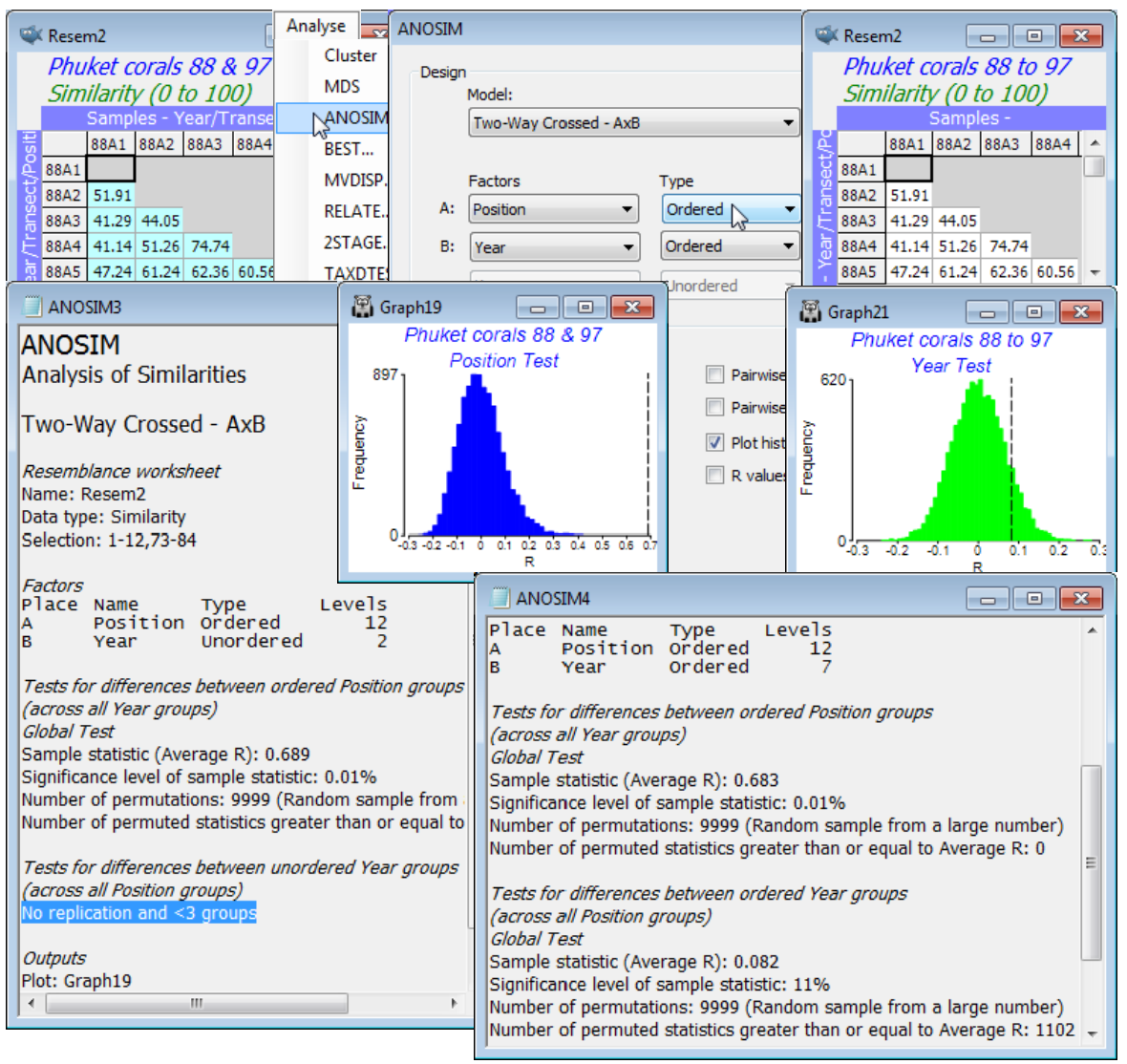
Run **Analyse>ANOSIM**>(Model•Two-Way Crossed - AxB)>(Factors A: Position Ordered & B: Year Unordered) on same resemblance selection as above, of the two years 88 and 97, together. This will, of course, produce a massively significant *Position* effect, with average R$^\text{O}$ = 0.69, and with (Max permutations: 9999) this is still off the top of the null distribution, p<0.01% (or, as a probability, P<0.0001). It is naturally a very powerful test, with $6 \times 10^{16}$ possible permutations.
It did not matter in this case whether the Year factor was defined as Unordered or Ordered, since there were only two years. The test for *Year*, removing the effect of *Position* by comparing years only within each of the 12 levels for *Position*, is doomed to failure, unsurprisingly. There are no replicates on which to base such a test (applying the above formula for an ordered test, *a*=2 so *a*!/2 = 1 and, whilst *b*=12 is large, powering up 1 still gives 1, i.e. there is only one permutation which is the observed configuration of the labels!). ANOSIM simply says *No replication and <3 groups*.
However, if we were to take off the selection, so reintroduce the full set of 7 years, and specify that both factors are ordered then there are ample steps in both the spatial gradient of 12 points and a temporal time trend of 7 points for an ordered test of either factor, removing the effect of the other. The *Position* test now gives a very similar R$^\text{O}$ = 0.69 as found for the two years alone but the *Year* test returns R$^\text{O}$ = 0.08, with about 1100 of the 9999 permutations created under the null hypothesis giving larger R$^\text{O}$ values than this (p<11%), a non-significant result. (Incidentally, note it is always true that a test of factor A is completely unchanged by whether factor B is assumed ordered or not).
In fact, whilst the original study postulated serial change in coral communities along the onshore-offshore transect, so that an ordered test for the *Position* factor seems very appropriate, it is not so clear that it is relevant to test for a monotonic inter-annual trend – a drift of the community in time, ever further away from its original configuration. Local impacts in some years may be dominant, and the possibility that these have a differential effect on the transect gradient (an *interaction* of a type) suggests a very different approach, using the **Analyse>2STAGE** routine, which we shall return to for these data in Section [14](https://learninghub.primer-e.com/books/primer-v7-user-manual-tutorial/chapter/14-further-matching-of-multivariate-patterns-relate-2stage-best-mvdisp). Within the ANOSIM routines however, the 2-way crossed layout for an unordered factor with no replication leaves few options for a non-parametric test, though sometimes helpful is a fall-back test (available in PRIMER since the early versions), which is next described for the Exe estuary nematode data. Save and close workspace Phuket ws.
[](https://learninghub.primer-e.com/uploads/images/gallery/2024-07/screenshotpage162a.png)