# 2-way RELATE for cyclicity
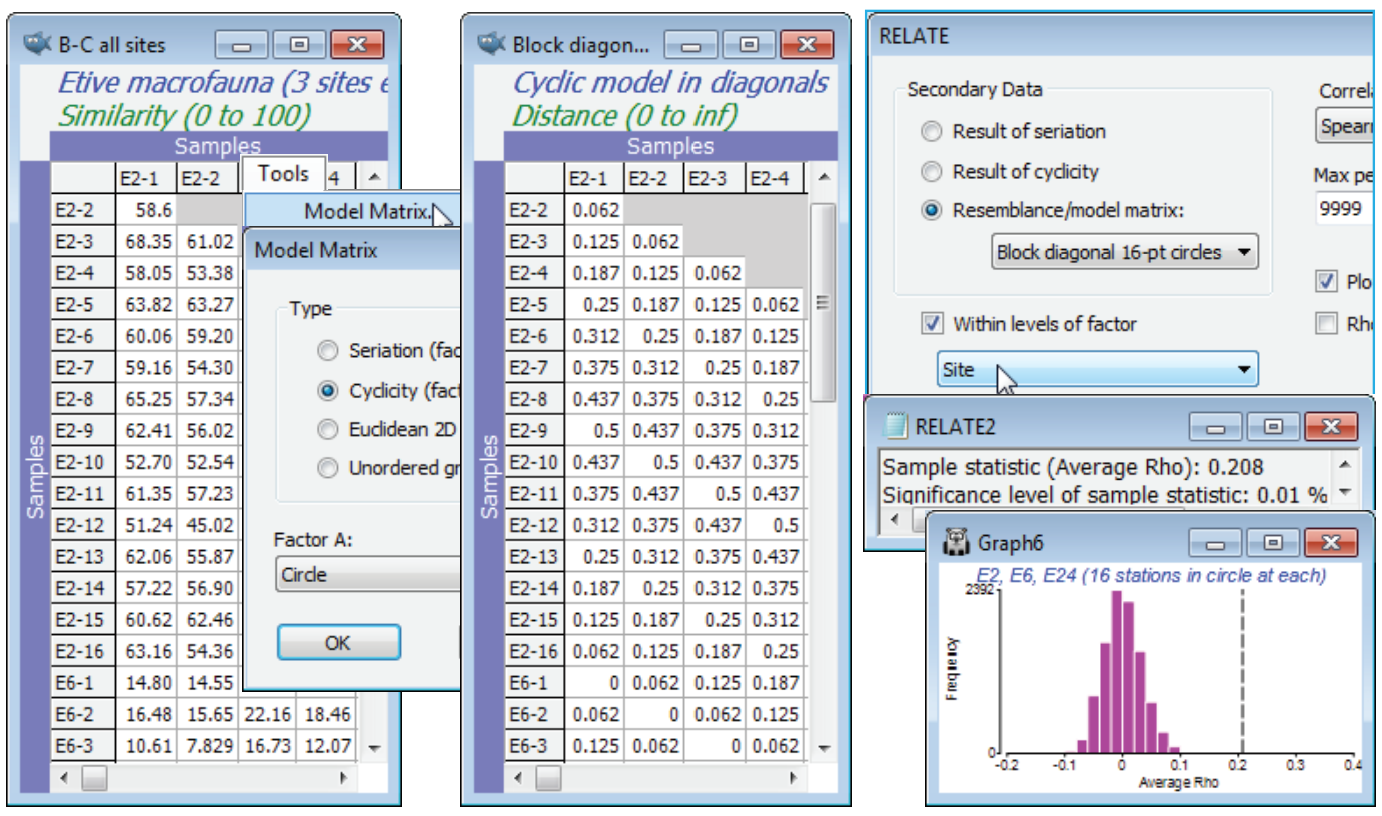
A 2-way RELATE version of the above test where there are no replicates, and the cyclic factor under test is actually nested within a ‘nuisance’ factor whose effect we want to remove, is given by reverting to the full data sheet for the Loch Etive macrofauna samples: **Select>All** and recompute the fourth-root transform and Bray-Curtis similarities, as B-C all sites, which now has 16 samples in a circle for each of the three sites E2, E6 and E24. Testing for a match with the circular spatial layout of stations, simultaneously at all three sites, whilst eliminating the inevitable differences in community composition for these three locations using 2-way RELATE, should give a still stronger test of the null hypothesis of no community differences within sites against this specific alternative.
As before, the model matrix is constructed by **Tools>Model Matrix**>(Type•Cyclicity) & (Factor A: Circle), run on B-C all sites, giving a model distance matrix (rename it Block diagonal 16-pt circles) in which only the block diagonals of the stations within sites will be sensible in this nested case (and which is all that RELATE uses) because, for example, station 1 at E2 and station 1 at E6 have nothing in common. On B-C all sites, **Analyse>RELATE**>(Secondary data•Resemblance/ model matrix: Block diagonal 16-pt circles) & (✓Within levels of factor Site) gives an averaged $\rho$ statistic across the three sites of 0.21, still strongly significant – note the tighter spread of the null histogram (c.f. Graph1 above) because of the simultaneous testing. The lower value than for the E2 test alone suggests weaker effects at E6 and E24, which is seen in separate (1-way) cyclic tests.
[](https://learninghub.primer-e.com/uploads/images/gallery/2024-10/screenshotpage250a.png)
More usually, the cyclic factor under test (often time) is crossed with a second factor (often space), whose effect we want to eliminate for our time test. The 2-way RELATE test structure is the same as for the above nested case however, and a more typical example is now given of a cyclic four-seasons series recorded for several regions, with the added complexity of replication within each of the cells of this 2-way layout. Though the structure is that of a 2-way crossed ANOSIM, this case is not covered by running an ordered ANOSIM test because, of course, the time factor is cyclic and not serial – an appropriate model matrix therefore needs to be created as an input to RELATE.