# Bray-Curtis similarity
The most commonly-used similarity coefficient for biological community analysis, because it obeys many of the ‘natural’ biological guidelines in a way that most other coefficients do not (see CiMC), is the Bray-Curtis similarity, defined between samples 1 and 2 as:
$$S _ {17} = 100 \left[ 1 - \frac{\sum_{i} | y_{i1} - y_{i2} | }{\sum_{i} y_{i1} + \sum_{i} y_{i2} } \right] \equiv
100 \frac{ \sum_i \min \left( y_{i1}, y_{i2} \right) }{ \left( \sum_{i} y_{i1} + \sum_{i} y_{i2} \right) \/ 2} .$$
The two forms may not look identical but they are! Here $y_{i1}$ is the count (or biomass, % cover, …) for the *i*th (of *p*) species from sample 1, and $\sum_i$(…) denotes summation over those species. Original references to coefficient definitions are not given here (nomenclature is always a source of debate!) – see L&L, whose numbering scheme is followed where possible, hence $S_{17}$ for Bray-Curtis.
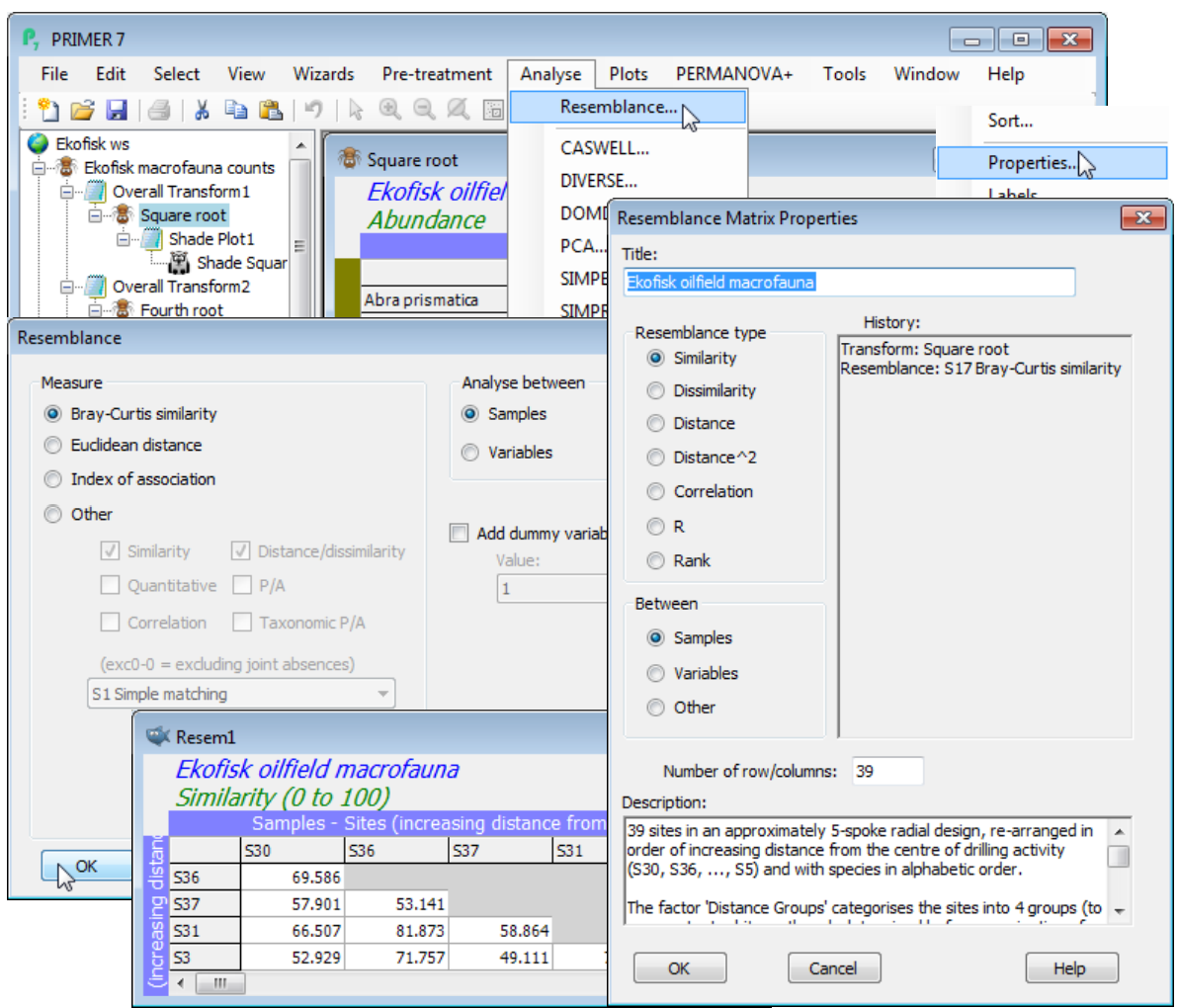
Open the workspace C:\Examples v7\Ekofisk macrofauna\\Ekofisk ws from earlier, and click on the Square root counts sheet (obtained earlier with **Pre-treatment>Transform(overall)**>Square root). Take **Analyse>Resemblance**>(Measure•Bray-Curtis similarity) & (Analyse between•Samples), which are the defaults for this data type. A lower triangular matrix is produced, Resem1, which you should rename B-C on sq rt. **Edit>Properties** (or right-clicking over the matrix to get **Properties**) shows it is of Resemblance type•Similarity from 39 samples. The History box carries through the knowledge of how it was created to a subsequent Cluster or MDS ordination plot. This box is not user-editable, though the Title and Description boxes can be altered; changes to the Title are carried forward to a subsequent plot but not backward to the data sheet Square root.
Now repeat **Resemblance** directly on the original Ekofisk macrofauna counts, without the **Pre-Treatment** transformation. PRIMER tries to help – a warning message appears that no transform has been applied; community matrices usually require some transformation before calculating Bray -Curtis (though you can happily ignore this warning if you are interested in the pattern of the few most dominant species only). **Cancel** the calculation and resave the Ekofisk ws workspace.
[](https://learninghub.primer-e.com/uploads/images/gallery/2024-05/screenshotpage66a.png)