# Species typifying a group
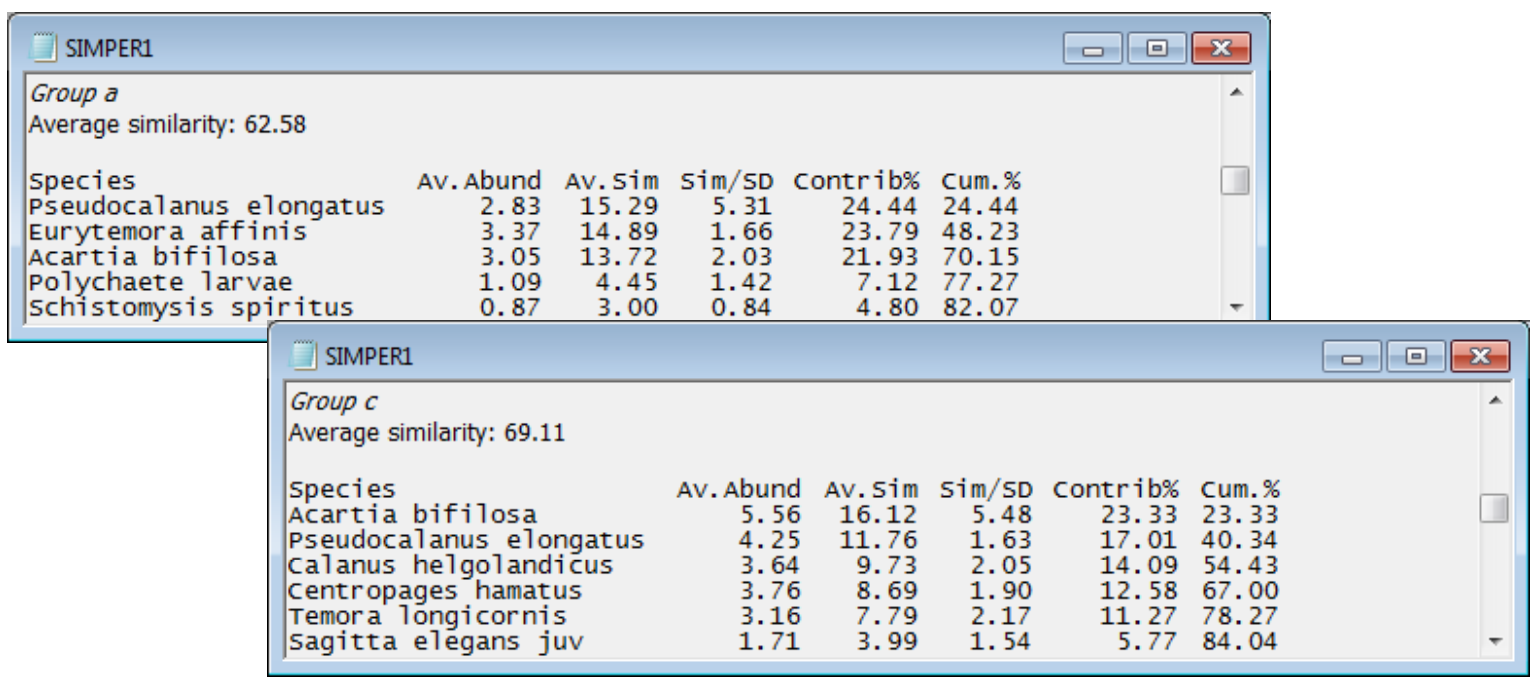
Earlier in the results window, tables are given of the contributions of each species to the Bray-Curtis similarity *within* each of the groups (see Chapter 7 of the methods manual for the formula).
[](https://learninghub.primer-e.com/uploads/images/gallery/2024-08/screenshotpage201a.png)
The average Bray-Curtis similarity between all pairs of sites in group *a* is 62.6, made up mainly of contributions from just three species: *P. elongatus* (15.3, i.e. 24.4% of total), *E. affinis* (14.9, i.e. 23.8%), *A. bifilosa* (13.7, i.e. 21.9%), with a cumulative contribution of 70.2% of the total within- group similarity (the list is again truncated at 80%). These species can be described as typical of *Group a* (they also have a consistently large presence because the ratio of their contribution to its SD, across the within-group similarities, is relatively high, notably for *P. elongatus*). However, *A. bifilosa* and *P. elongatus* are also typical of group *c*, which is why they do not head the list of those contributing most to the discrimination between *a* and *c*. They did feature lower down in that list, since both have higher average (transformed) values in *c* than in *a* (column 1 and earlier shade plot).
Save and close the Bristol Channel ws workspace, and if you would like to try another example of SIMPER on a 1-way layout – but this time with *a priori groups* – open the WA fish ws workspace examined in Section [9](https://learninghub.primer-e.com/books/primer-v7-user-manual-tutorial/chapter/9-analysis-of-similarity-tests-unordered-and-ordered-anosim), where ANOSIM tests showed that all pairwise comparisons of (predator) fish species gave significantly different (prey) diets, except two pairs involving *S. robustus*, for which therefore you should not attempt to interpret the SIMPER table of discriminating species.