# Use of factors
With Tasmania nematodes as the active window, select **Edit>Factors** from the main menu (or use the shortcut right click when the cursor is over the data matrix to bring up a combination mainly of the Edit and Select menus), and observe that there are already two factors defined. The treatment factor *Treatment* splits the 16 Tasmanian sandflat samples into two levels, namely whether they are from disturbed (D) or undisturbed (U) areas of sediment. The *Block* factor divides the samples up in a different way, into four levels, the four separate sampling patches across the sandflat (1 to 4). In statistical terminology, the treatment and block factors are crossed, meaning that there are samples at every combination of levels of the first and second factors. Factors are heavily used throughout PRIMER, in at least two main ways:
a) to define a group structure for multivariate hypothesis testing (e.g. ANOSIM, see Chapter 6 of the CiMC manual). Such *a priori* structuring of the samples (i.e. prior to seeing the data) plays an important role in formal inference about sample patterns, and also the interpretation of which variables (e.g. species) are primarily responsible for distinguishing specific groups (Chapter 7);
b) purely as a means of labelling points on plots, in dendrograms etc., in which case there might be a different ‘level’ for every sample, e.g. a fuller or more abbreviated site name than is held in the sample label. There is no limit on the length or alphanumeric content of a factor level.
Factors are carried around and saved as part of the data sheet they are linked to, and not saved as separately named data sheets. This is in contrast to (numeric) environmental variables associated with each biological sample, which are held in a separate sheet – preferably with the same sample labels as the biota, and which could have some or all of the same (categorical) factors defined. To emphasise that block designation is purely a category here, not a numeric sequence, a new factor *Blk* will be added here, with levels B1, B2, .. not 1, 2, … (as seen in the previous text file versions).
[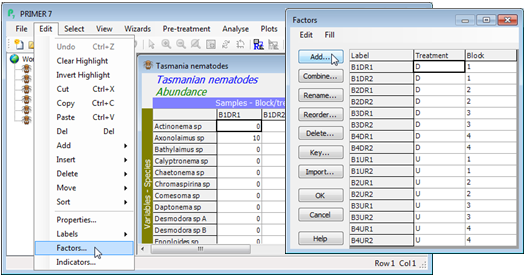](https://learninghub.primer-e.com/uploads/images/gallery/2024-05/screenshotpage37a.png)