
13.1 Overview
PRIMER 8 offers a host of new options for standardising data (either samples or variables), via the menu item: Pre-treatment > Standardise. The new 'Standardise' dialog window in PRIMER 8, by comparison with that in PRIMER 7, is shown below (Fig. 13.1).
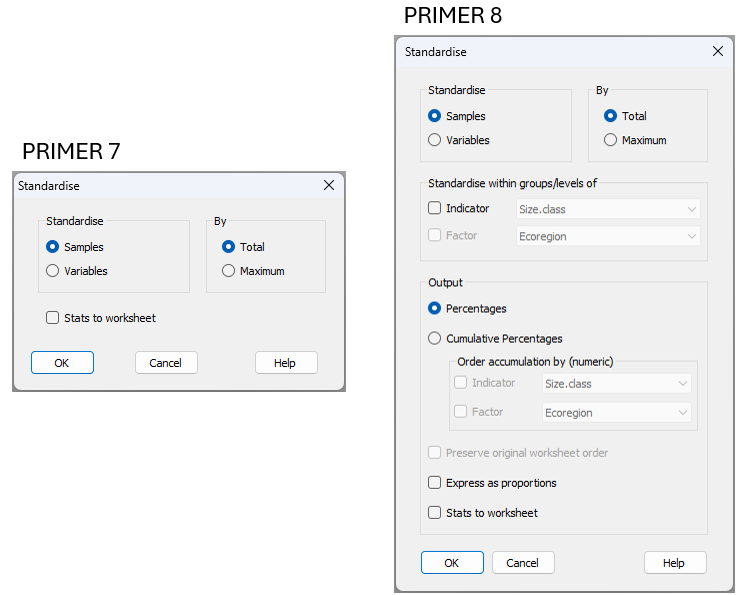
Fig. 13.1 Dialog for standardising samples or variables in PRIMER 8 by comparison with that available in PRIMER 7.
The two essential expansions to this tool in PRIMER 8 are:
- You can output the standardised data either directly (as calculated) or cumulatively (ordered as in the data sheet, or optionally ordered by a factor/indicator) as either percentages or proportions; and
- You can perform standardisations:
- across samples, but done separately for different sets of variables identified by an Indicator; or
- across variables, but done separately for different sets of samples identified by a Factor.
Option (1) above enhances the ability of PRIMER 8 to handle datasets where the variables themselves are ordered in some fashion. For example, perhaps the multivariate variables are:
- size-class fractions in sediment samples;
- abundances of organisms in different size classes (i.e., size-frequency data);
- growth curves where individuals are monitored over time and their sizes recorded at different time points. So, individual time points are different variables, and these have a natural order.
Option (2) above enhances the ability of PRIMER 8 to handle various situations much more easily. For example, suppose you have multiple species, and in every sampling unit there are tallies for each of several size classes for each of the species. For this case, we might want to do the standardisation cumulatively across the size classes, but it makes sense to do so separately within each set of variables that belong to a particular species. In such a case, the species (to which each size-class variable belongs) can be given as an indicator. Another example could be sets of variables that consist of tallies across multiple categories, within each of several traits. In this case, we would want the standardisation to be done separately for each trait. In either of these examples, the standardisation task would be quite laborious were it not for the new PRIMER 8 standardisation tool.